
Abort: The Exile
2024 Silver Winner at the MUSE Creative Awards


Overview
Engine: Unity
Role: Level Design, Quest Design
Level Type: Single-player stealth / psychological horror
Team Size: 30 people
Abort: The Exile is a 3D horror adventure game that takes you to the early 2000s in China, where you'll unravel the unsettling mysteries of the Zhang family.
Macro Summary
In this sequence, the player takes on the role of Debao. After waking in his room, he learns that his parents left him a birthday gift in the main hall. There, the player acquires the camera, uses it to uncover the house’s hidden history. After obtaining a key and surviving a chase with hostile spirits, the player enters Ruonan’s locked room, where fragmented objects reveal her suppressed life and unrealized future. Debao then returns to the main hall with the key object needed to complete the ritual and push the mansion into its next narrative stage.


Key Relationships
Debao is the player’s point of entry into the family’s buried history. Ruonan, his sister, is the central tragic figure whose life has been reduced to marriage transaction and sacrifice. Debao’s parents and the groom’s family are complicit in the oppressive structure behind that exchange. Qingzhen embodies the accumulated resentment of women harmed and erased within that system, serving as an escalating supernatural threat throughout the mansion.
Player Goals
Find the camera in the main hall, uncover the truth behind Ruonan’s marriage, gain access to Ruonan’s locked room, recover the university acceptance letter that represents her lost future, and return to the hall to complete the scale puzzle and advance the ritual.
Key Mechanics
-
Movement - walk, run, crouch
-
Interact - collect, use, QTE (environmental enemy), inspection
-
Save/load
-
Camera
-
Diary
-
Backpack Inventory
-
Enemy
Camera

Players use the mystical camera to expose haunted artifacts, and the flashing sound also attract nearby, which contribute strategically to the stealth and environmental puzzle-solving gameplay.
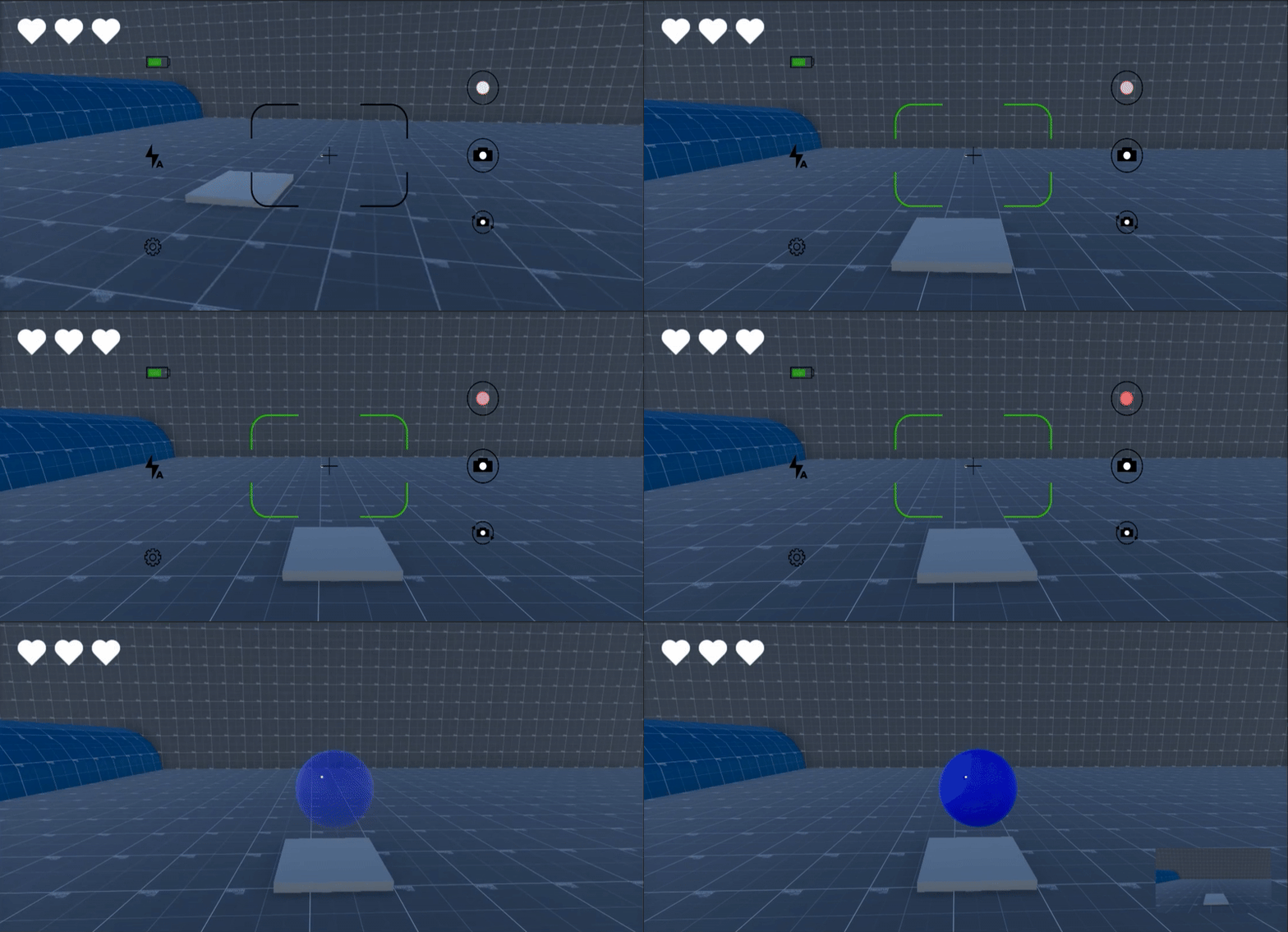
Made a prototype that shows the red light flashes faster as you get closer to the object, and the viewfinder in the center turns green when you’re facing it.
Level Design
Core Theme
The mansion is designed as a narrative map of feudal family structure. Each room reflects the role, status, and repression of its inhabitant, while the estate as a whole functions as a system of control that shapes how the player moves, hides, and uncovers the story.

Design Goals
Goal 1:
Use the mansion’s architecture to express family hierarchy and conflict


I used a symmetrical core layout centered on the main hall and courtyard to establish a sense of ritual order and rigid family structure. Room placement then differentiates hierarchy within that order: more powerful family members are positioned closer to the mansion’s central axis and public ceremonial spaces, while other rooms are placed along more constrained or peripheral routes.
I also used circulation to reinforce control, making some paths more exposed and formal while others feel hidden, restricted, or subordinate. As the level progresses, this initial symmetry is gradually destabilized through room-specific identities and staged spatial changes, allowing the mansion’s structure to reflect both family hierarchy and underlying conflict.
Goal 2:
Create stealth tension through constrained navigation and sightline control
.jpg)
I made this early 2D flow diagram to map how the player moves between safe pockets, exploratory spaces, high-pressure stealth routes, and escape beats before full 3D blockout. This helped me control where tension builds, where players can briefly reorient, and where movement becomes more vulnerable or restricted.
Techniques I used:
#1 Hub-and-branch progression
The mansion is organized around a central circulation loop connecting the second-floor corridor, the stair transition, and the main hall, with branch spaces such as Debao’s room and Ruonan’s room extending from that core. This helps players build familiarity with the house early while supporting controlled returns to key spaces later.
#2 Pacing distribution across the route network
I used the macro flow to create a clear tension curve across the mansion. Debao’s room color-coded as a low-pressure onboarding area, the second-floor corridor introduces the first stealth bypass, and the main hall expands into a longer puzzle and exploration sequence before escalating into a higher-pressure escape space. This creates a rhythm of curiosity, caution, fear, and release rather than a single static intensity.
#3 Gated progression through narrative discovery
Progression is gated through both spatial access and narrative triggers. The camera tutorial in the main hall reveals the hidden logic of Ruonan’s arranged marriage while pushing the player toward Ruonan’s room. The scissors then function as a key that unlocks a previously blocked route, tying item acquisition, story revelation, and spatial expansion together.


Constrained navigation and blind corners
I used narrow corridors, sharp turns, and layered transitions to restrict forward visibility and prevent the player from fully reading what lies ahead. These tighter passages create hesitation and force players to move carefully, especially when approaching corners, thresholds, or spaces with interrupted sightlines.


After tighter transitions, more open spaces briefly restore orientation and spatial readability. These moments act as short resets in the tension curve before the player re-enters more constrained routes.
Goal 3:
Spatial reuse as an environmental storytelling tool
I used repeated traversal to make familiar routes feel different over time, allowing the mansion to be re-read through new narrative context and spatial change. As players return to previously visited spaces, subtle shifts in layout, access, and atmosphere turn backtracking into a way of revealing story, destabilizing memory, and deepening psychological tension.
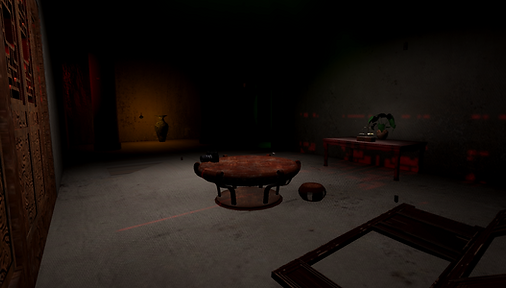

#1 Revisit the same routes under different threat conditions
I reused key routes such as Debao’s room, the second-floor corridor, and the main hall across multiple stages of the game, but changed how they functioned over time. A corridor that first serves as simple traversal later becomes a stealth bypass around one of the hostile ghosts, Qingzhen, and eventually turns into a dangerous escape route with increased enemy pressure.
#2 Transform the same spaces through narrative and environmental change
I used staged environmental changes to alter how repeated spaces were read. The main hall evolves from a ruined ancestral space into a vivid matchmaking scene and later into a wedding stage, while Ruonan’s storage room gradually transforms into her former bedroom. This allows the mansion to reveal hidden family history through spatial change rather than exposition alone.
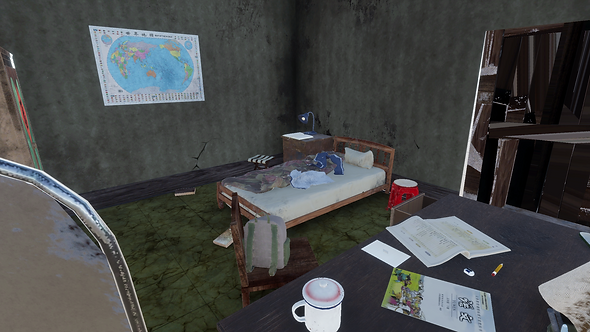
#3 Tie every return to new story stakes and tools
Each return to a familiar space is tied to new narrative information, objectives, or mechanics. The player may revisit a known route with a newly acquired key item, a different emotional understanding of the family, or under increased supernatural threat. This keeps backtracking from feeling like filler and turns repeated traversal into a way of escalating both story and tension.

Environmental Storytelling through Quests
Scale Puzzle
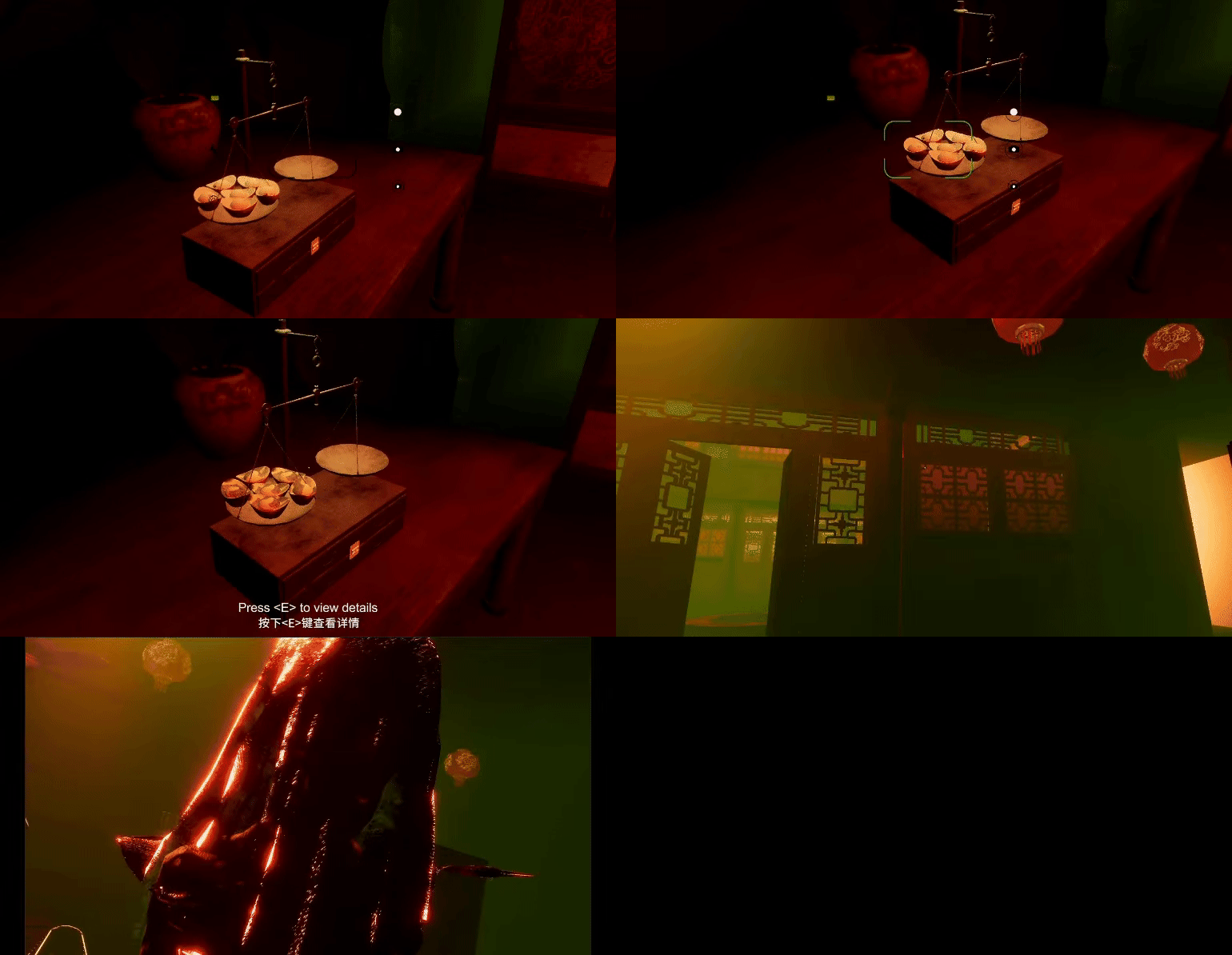
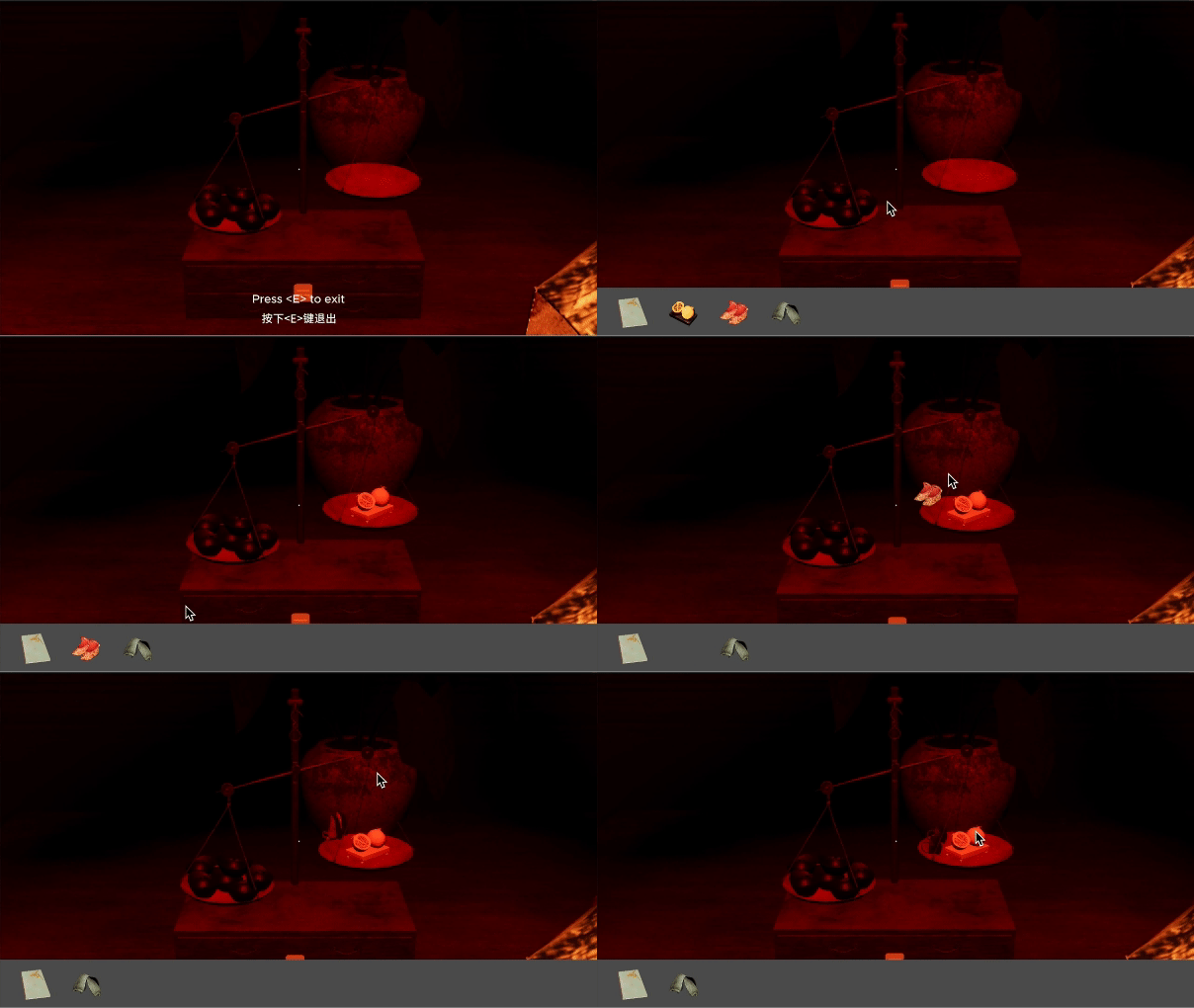
This is a balancing puzzle in which players collect hidden objects from the environment and use them to counterbalance a pile of gold ingots on a scale.
To bring the scale back to balance, the player must use camera to search the hall for three hidden objects that hold the last traces of the sister, Ruonan's life.
Design Goal:
Mechanically, the puzzle trains players to read the environment, using the camera to uncover and collect easily overlooked objects. This creates a more deliberate search pattern while directing player attention toward narrative details embedded in the space.
Narratively, the scale puzzle helps players uncover more about Ruonan's story and the nature of this arranged marriage. By weighing symbolic objects against gold, the puzzle frames her marriage as a transaction, reducing her body and future to exchange value.
Took account for all of the possible interactions and edge cases for this puzzle.

Tracing Puzzle
This tracing prototype places players in the perspective of Ruonan the sister, who secretly practices calligraphy, hoping to enter a competition. Despite her parent's belief that girls shouldn’t waste time studying, writing becomes her act of resistance.
The design goal is to let players feel her determination and vulnerability through the mechanics:
each stroke must begin carefully, follow the proper order, and stay within gentle boundaries that reflect the pressure she lives under.
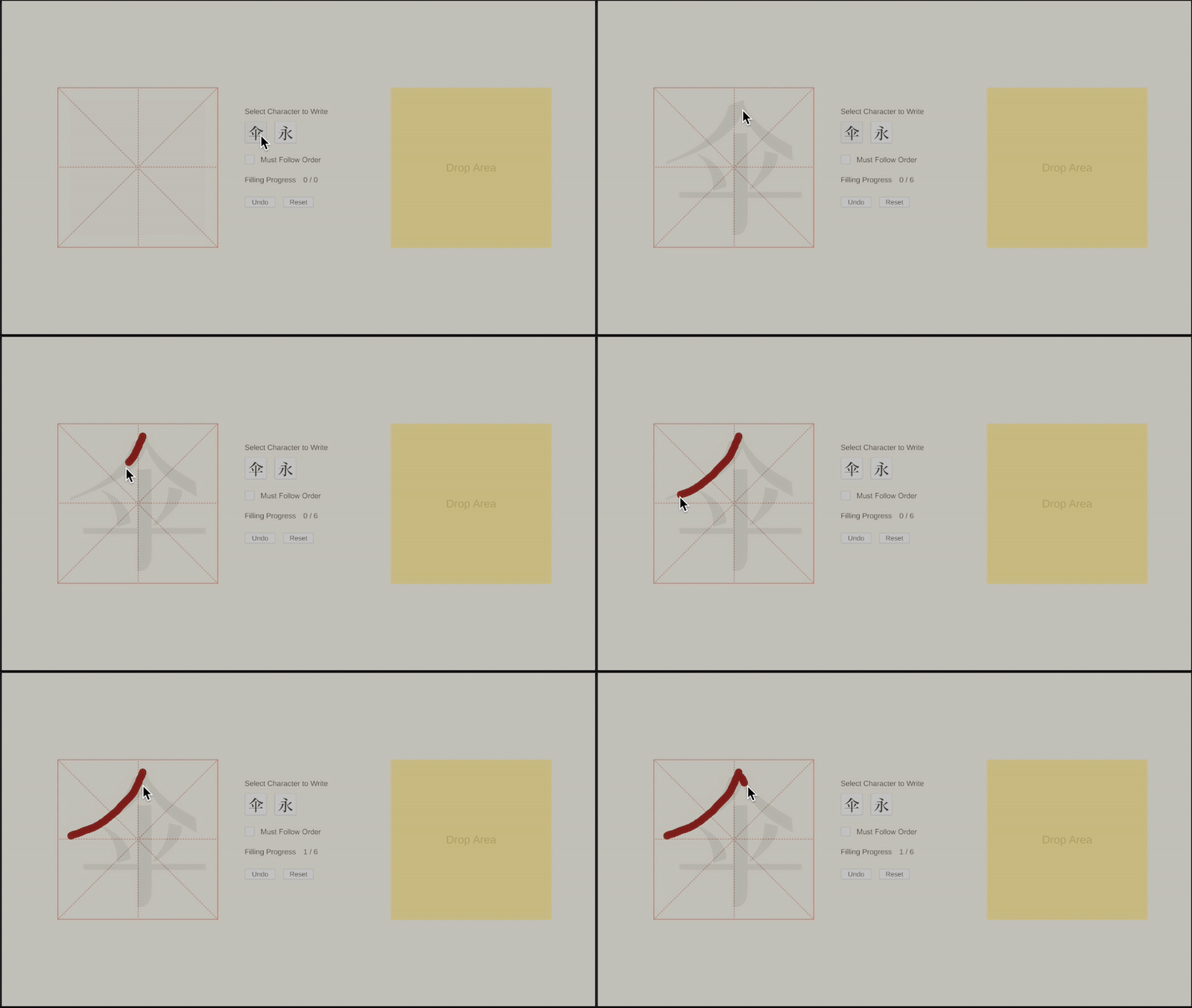
A diagram to validate logic, and further communicate the inputs and the feedbacks.
